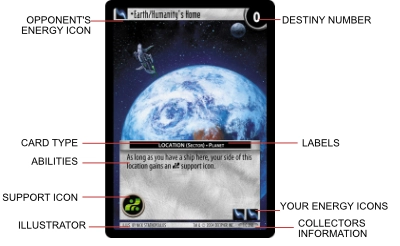
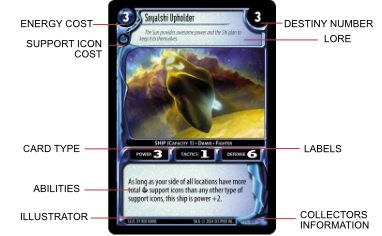
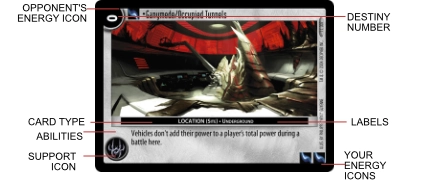
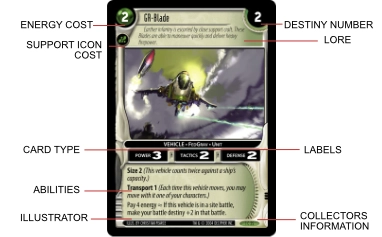
This online document is a direct copy of the Comprehensive Rulebook Version 1.5 dated 15 March 2005. (Bullet point formatting has been used for easier readability). An updated Players Committee Rulebook is in progress. This document will not be modified.
You may ask to see your opponent’s cards that are stacked beneath other cards (such as characters aboard a ship or a weapon beneath a character) at any time.
These cards are not hidden information.
building a deck
Each deck must contain exactly 60 cards.
You must include at least one location in those 60 cards (to start the game with).
You may include no more than four copies of a single card. (Some cards are unlimited, and you may include any number of copies of those cards in your deck.)
can’t
Any time one card allows you to do something and a different card says you can’t, the latter card takes precedence.
If one card says “Move target unit to an adjacent site,” and another card says “This unit can’t move until end of turn,” then you can’t use the first card to move that unit.
in play
A card is not in play when that card is in a hand, reserve, active pile, used pile, lost pile, stacked on another card, pending on the stack, or removed from the game. Interrupts and orders are never in play. All other cards are in play. A card which is put out of play from in play is said to be leaving play.
leaving play
When a card leaves play for any reason, all cards beneath it are lost. This includes such cards as units aboard ships and weapons and assets that belong to characters. Some cards stack other cards on top of them, and when they leave play, those stacked cards are lost. Such stacked cards leave play as well. Any cards that leave play lose any status like “damaged” or “inverted.”
look
When a player looks at a card, that card is completely shown to only that player.
Usually, that card is put back where it came from.
owner
You are the owner of every card in your deck when the game begins. Card effects can allow you to use your opponent’s card as yours during the game, but your opponent remains the owner of that card.
reveal
When either player reveals a card, that card is completely shown to both players.
Usually, you put that card back where it came from.
starting the game
Determine which player will take the first turn either at random or using any method both players agree to.
Each player searches his or her deck for a location. Reveal your choices at the same time, and put them in the middle of the play area. If the beginnings of their titles are the same (the parts before the slash / symbol), place them adjacent to each other. Otherwise, place them separately.
Shuffle the rest of your deck, place it face down in your reserve, then draw the top eight cards to form your opening hand.
systematic rules
At any time a player would receive initiative, the systematic rules check for various things which resolve immediately. These include:
canceling a battle
If there are no characters, vehicles, or ships on one side of a battle, before the end of the battle step, then that battle is canceled. That battle ends immediately with no winner, no loser, and no casualties. Any damaged cards are lost. Any abilities or cards on the stack are canceled.
winning the game
If a player has no cards in his or her reserve, used pile, and active pile, that player’s opponent wins the game.
In the unlikely event that both players have no cards at the same time, the game is a draw.
(In tournament play, tie breakers apply and the result of a game is never a draw.)
turn sequence
Each turn has six phases which occur in order.
When the first player completes all six phases of the turn, his or her opponent takes a turn, and so on back and forth until one of the players wins the game.
1. Activate Phase
You may activate energy from your reserve to your active pile.
2. Control Phase
You may drain energy at each location you control.
3. Deploy Phase
You may play cards from your hand.
4. Battle Phase
You may begin a battle at each location where both players have a unit and/or ship.
Battle Destiny Step
Attrition Step
Power Step
Loss Step
End of Battle Step
5. Move Phase
You may perform movement actions to move your ships and units.
6. Draw Phase
You may draw cards from the top of your active pile.
End of Turn
Section Two: Glossary
abilities
Abilities explain what a card does in the game. Some cards have more than one ability, each separated by a line break.
There are three different kinds of abilities you can find on a card: an activated ability, a triggered ability, and an ongoing ability.
activate
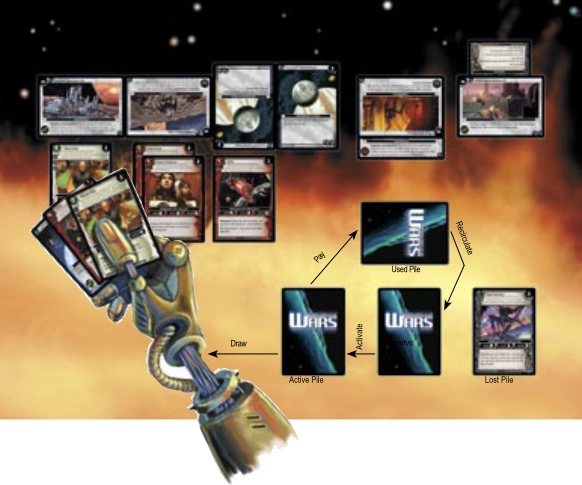
At the start of the game, all your energy is in a pile called your reserve. You must activate that energy before it can be used to play your cards. When you activate an amount of energy, you take that number of cards one at a time from the top of your reserve and put them on top of your active pile without looking at them.
activate phase
During this phase, you may perform an activation action. You may do this only once during each of your activate phases.
You may play interrupts and/or use activated abilities during this phase as well, before and after your activation action.
activated ability
An activated ability is any ability that contains a rift (≈) symbol. You choose when to use activated abilities on your cards in play, during your turn or your opponent’s. The part before the ≈ is the cost you must pay to do this. The part after the ≈ is the effect you perform each time you pay the cost.
Some activated abilities also have one or more bullet (•) symbols.
activation action
You may perform only one activation action during each of your activate phases.
Total the amount of energy generated for you by the energy icons on all locations, then add 1 to that total. You may activate up to this much energy.
You and your opponent have each played one location. One has no energy icons on the side facing you, and the other has two. You may activate up to three energy (0+2+1). You may choose to activate less. Whatever amount you choose to activate, you take that number of cards one at a time from the top of your reserve and put them on top of your active pile without looking at them.
When you perform an activation action, you must declare how much energy you are activating. You can only perform this action once during your turn. You may activate energy in other ways, such as interrupts or activated abilities. The activation action goes on the stack.
I choose to perform an activation action. I count 7 energy icons available. I announce 3, instead of 8. That goes on the stack. When both players pass consecutively, my activation comes off the stack, and I activate 3. I can’t perform another activation action to get the other 5.
active pile
When a player activates energy, that player takes the top card of his or her reserve and places it face down on his or her active pile. A player always has an active pile, even if there are no cards in it.
Cards in a player’s active pile are used to pay energy costs by moving the top card of the active pile face down on top of the used pile.
asset
An asset is an ongoing strategic advantage you can use throughout the game. Some assets are played beneath other cards.
You may play an asset when the stack is empty during your deploy phase.
There are several kinds of assets: (CHARACTER), (SITE), (SECTOR), (LOCATION), (KIZEN), and so on. When an asset enters play, play it on the table by itself unless it has a kind in parentheses, in which case you must choose your target card of that kind where your asset will enter play, stacked beneath it.
Usually, you can only play your asset beneath one of your cards. Some assets allow you to play them beneath your opponent’s cards as well.
When an asset has an ability that stacks cards on it, those cards are not in play, and they do not count for uniqueness. A unique card stacked on an asset may be in play elsewhere. Multiple copies of the same unique card may be stacked on the same asset.
Usually, a card may have any number of assets beneath it. Some assets have an ability that says you can only play one of that asset beneath a particular card.
attack action
You pay 1 energy and choose a target location where both you and your opponent have units and/or ships to begin an attack action, which goes on the stack and begins a battle when it resolves.
You may attack one time at each location where both players have a unit and/or ship. Each location may have only one attack action targeting it during each battle phase, but units and/or ships may participate in more than one battle in each battle phase.
battle phase
In this phase, you may perform attack actions. Each attack begins a battle with your opponent – a sector battle or a site battle, depending on the type of location targeted by the attack.
Each battle has five steps which occur in order. You must complete each of these steps, ending one battle, before you may perform another attack action.
Before each step of the battle, both players can play interrupts and/or use activated abilities. The player whose turn it is goes first. When both players consecutively pass on the opportunity to do so, the next step begins.
During each step of the battle, neither player has initiative. When each battle step is completed, the player whose turn it is regains initiative. Note that triggered abilities may still affect a battle step even though neither player has initiative.
There is always only one battle destiny for each side. Cards do not add “another battle destiny,” they simply add (D) to your systematic battle destiny.
A side has a battle destiny of zero and causes attrition of zero as soon as a battle begins. Card effects may add directly to these totals even if no battle destiny card is revealed.
You have a unit with power 1 and tactics 1 alone in a site battle. You may play an interrupt that adds 1 to the attrition you cause (only) or an interrupt that adds 1 to your battle destiny (1 to power and 1 to attrition both).
Sometimes after a battle has begun, all of the ships and units belonging to one player are destroyed, dismissed, or otherwise removed from the battle. If this happens, skip immediately to the end of battle step. There is no winner or loser, and no energy is lost.
Following is a description of how the steps of a single battle work. The “attacker” is the player who performed the attack action. The “defender” is the other player.
1. attack action
Attacker pays 1 energy and chooses target location. Goes on stack. Resolves, battle begins. Both sides now have battle destiny = 0 and attrition = 0.
2. play interrupts/use activated abilities
Both players have the opportunity to play interrupts and use activated abilities. This is the last opportunity to perform actions that affect battle destiny. When both players pass consecutively and the stack is empty, the battle destiny step begins.
3. battle destiny step
Each player determines his or her own battle destiny in the battle, to be used in the next two steps. First, you add the tactics of some of your cards in the battle. In a site battle, you add the tactics of all your units in the battle. In a sector battle, you add the tactics of all your ships in the battle (but not any units aboard them).
When this step begins, battle destiny can’t be modified by interrupts/activated abilities, although triggered abilities may still affect it.
In either case, if that total tactics is 4 or more, you may reveal one card for battle destiny (in the same manner you reveal a card for any other destiny). Cards and abilities can affect your battle destiny, even if you don’t reveal a card to add to your battle destiny.
You have three units in a site battle. One has tactics 2, and the other two each have tactics 3. Your total tactics is 8. Because that is 4 or more, you reveal a card for battle destiny. The destiny you reveal is 5.
While other cards and abilities may add or subtract from your battle destiny, only this card is “revealed for battle destiny” for purposes of other cards that use that phrase.
Revealing battle destiny does not go on the stack. First the attacker reveals battle destiny, then the defender reveals battle destiny.
4. play interrupts/use activated abilities
Both players have the opportunity to play interrupts and use activated abilities. This is the last opportunity to perform actions that affect attrition. When both players pass consecutively and the stack is empty, the attrition step begins.
5. attrition step
You now cause attrition against your opponent equal to your battle destiny. Cards and abilities can affect the attrition you cause, even if you haven’t revealed a card to add to your battle destiny.
If your opponent causes you attrition, you must damage your ships and/or units in that battle. You choose and damage these cards one at a time, until the total defense of those cards equals the attrition your opponent caused. You can’t damage more cards than this, although sometimes the last card you damage will go beyond the total defense required. (You don’t “make change” in such cases.)
Your opponent must damage units in the battle for the 5 attrition your battle destiny caused him. Meanwhile, he has a battle destiny of 4, and is causing you 4 attrition. You damage one of your units that has defense 3. You then damage another that has defense 2. You’ve gone 1 beyond the 4 total defense you had to damage. Your third unit remains undamaged.
If your opponent causes you attrition, and every one of your undamaged ships and undamaged units in the battle is “immune to attrition,” you may ignore the rest of that attrition and choose to damage no more cards. You may damage a unit that is immune to attrition if you want to.
If you have undamaged units and/or ships in a battle which are not immune to attrition, you must continue to damage them as long as any attrition remains. You can choose to damage a card with defense of 0 as long as there is any attrition remaining.
You suffer 5 attrition. You have unit with defense of 5 and another with defense of 0 at the site. You can damage the 0 before you damage the 5.
If no attrition remains, you can’t damage any more units.
You suffer 5 attrition. You have a 5 and a 0 at the site. Once you have damaged the 5, you can’t damage the 0.
Any of your cards that have been damaged before this step still apply their total defense against your opponent’s attrition.
When this step begins, attrition can’t be modified by interrupts/activated abilities, although triggered abilities may still affect it.
First the attacker satisfies attrition with the following procedure, then the defender does so. The actions taken during this procedure do not go on the stack.
Attrition Procedure: Player checks attrition against him or her. If attrition is not yet satisfied (if the total defense of the ships and units he has damaged at the battle location does not equal or exceed that attrition), he or she must damage a ship or unit in that battle. Repeat this procedure until either (a) all attrition is satisfied or (b) that player has no remaining undamaged ships and units in that battle.
6. play interrupts/use activated abilities
Both players have the opportunity to play interrupts and use activated abilities. This is the last opportunity to perform actions that affect power. When both players pass consecutively and the stack is empty, the Power Step begins.
7. power step
Each player determines his or her own total power in the battle. In a site battle, add the power of all your units in the battle. In a sector battle, add the power of all your ships in the battle (but not any units aboard them). In both kinds of battle, you also add your battle destiny as determined in the earlier step. Other cards and abilities can affect your total power.
When this step begins, each player’s total power can’t be modified by interrupts/activated abilities, although triggered abilities may still affect it.
The side with the most power is the winner and the other side is the loser. If the total power of both sides is equal, there is no winner and no loser.
You add up the total power of your three units in the battle, including the two damaged ones. One has power 3, another has power 2, and the third has power 5. You also add your battle destiny of 5, giving you a total power of 15 in the battle. Your opponent’s total power is 8. You win the battle.
The difference between the winner’s total power and the loser’s total power is the casualties suffered by the loser.
8. play interrupts/use activated abilities
Both players have the opportunity to play interrupts and use activated abilities. This is the last opportunity to perform actions to affect casualties. When both players pass consecutively and the stack is empty, the loss step begins.
9. loss step
If you lose the battle, you must lose energy equal to your casualties. Any of your units and/or ships in the battle that are damaged reduce your casualties by their defense.
You may further reduce your casualties by choosing to damage additional units and/or ships you have in the battle. You can’t damage more cards once you’ve reduced your casualties to 0, although sometimes the last card you damage will go beyond the total amount of your casualties. (You don’t “make change” in such cases.)
Your opponent has 7 casualties, because you beat him 15 to 8. He already has a damaged unit from the attrition step that has defense 5, which reduces his casualties to 2. He could choose to damage another unit to continue reducing the loss, but decides to lose energy instead. He does this in any combination from his reserve, active pile, and used pile. He can also lose cards from his hand. He decides to lose a card from his hand, and the top card of his reserve.
When this step begins, casualties can’t be modified by interrupts/activated abilities, although triggered abilities may still affect them.
The difference between the total power of the winner and the loser is the casualties that the loser must satisfy. If the total power of both sides is equal, there are no casualties. The loser must satisfy casualties with the following procedure. The actions taken during this procedure do not go on the stack.
Casualties Procedure: Loser checks remaining casualties. If any casualties remain (if the total amount of energy lost, cards lost from hand, and total defense of the ships and units he or she has damaged does not equal or exceed the number of casualties), then loser must attempt to satisfy them (either lose an energy, lose a card from hand, or damage a ship or unit). Repeat this procedure until all casualties are satisfied. If the loser can’t satisfy all casualties the battle is canceled, and that player loses the game according to the systematic rules.
10. play interrupts/use activated abilities
Both players have the opportunity to play interrupts and use activated abilities. This is the last and possibly the most effective time to use a weapon ability or any other ability that can only be performed during battle. When both players pass consecutively and the stack is empty, the end of battle step begins.
11. end of battle step
When this step begins, each damaged card must be destroyed. First, the attacker destroys all of his or her damaged cards, in any order he chooses. Then, the defender does the same. When all damaged cards are destroyed, the battle ends. Note that a damaged card which is not at the location of the battle must still be destroyed.
As this battle ends, two of your units are damaged, from earlier during the attrition step. They are now both destroyed, and so is your opponent’s damaged unit.
battleground
A location is a battleground if these three conditions are true:
1) There is at least one energy icon on each side of the location;
2) Nothing prevents a player from playing a ship (if it’s a sector) or unit (if it’s a site) to the location; and
3) Nothing prevents a player from beginning a battle at the location.
bullet (•)
If an interrupt (or activated ability) has a bullet (•) symbol before its title (or at the beginning of its game text), you can only play a copy of that interrupt (or use that activated ability) once during each player’s turn for each such symbol.
Your unit has the ability “• Pay 2 energy ≈ Draw a card from your reserve.” The • symbol tells you that you may use this ability only once during a single turn.
An interrupt or activated ability that has its use limited by one or more bullet (•) symbols “spends” one of those usages even if that usage is canceled.
You play Syndicate Interference, and your opponent cancels that with Outmaneuvered. You can’t play Syndicate Interference again this turn.
cancel
When a card is canceled, that card is lost. Put it in its owner’s lost pile. When a used interrupt or used order is canceled, that card is lost, not used. When an ability is canceled, that ability simply does not have its effect.
You play the used interrupt Anticipation but your opponent plays Trumped, which cancels the interrupt. Even though it’s a used interrupt, when the card itself is canceled, Anticipation is lost.
Sometimes only the effect of a used interrupt (or used order) is canceled and that card goes to the used pile.
You play the used interrupt Anticipation but before it resolves, your target kizen is destroyed. The effect of that card is canceled, but the card itself still goes to your used pile.
capacity
Each ship has a capacity listed on its card type line in parentheses. This is the maximum number of units of size 1 that may be played aboard (stacked beneath) that ship. When you play a unit aboard a ship, that ship must have sufficient capacity remaining. Units that have the size keyword ability require more capacity to be played aboard a ship. Note that capacity is checked only when a unit is played aboard a ship.
If you play Hannya aboard your ship that has capacity 3 when she is not inverted and has size 1, you can’t then play Deigan aboard that ship since she has size 3 and only 2 capacity remain.
Your ship of capacity 4 has Hannya, not inverted and size 1, and Deigan aboard. This ship has no capacity remaining. Since capacity is only checked when a unit is played aboard a ship, you use the ability on Hannya to invert her, and now you have two size 3 units aboard a capacity 4 ship.
captain
This ability on a ship identifies a character card, and as long as that character is aboard that ship, the ship and all units aboard it are immune to attrition.
casualties
When you lose a battle, your casualties are equal to the difference between your total power and your opponent’s total power.
character
A character is a type of card that represents one or more beings (including bots and aliens) which you send into battle against your opponent’s forces at ground locations.
You may play a character when the stack is empty during your deploy phase.
You must choose either target site or your target ship where your character will enter play.
If you choose a site, it must have at least one energy icon on your side of it, unless you already have another unit at that site.
If you choose your ship, it must have sufficient capacity remaining. Play your character aboard (stacked beneath) the ship.
Each character, vehicle, and NōBot has the label of UNIT.
control
You control each location where you have at least one ship or unit and your opponent doesn’t.
control phase
In this phase, you may perform drain actions.
You may play interrupts and/or use activated abilities during this phase as well, before, between, and after your drain actions.
costs
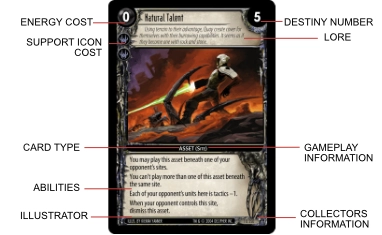
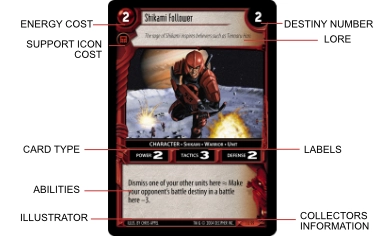
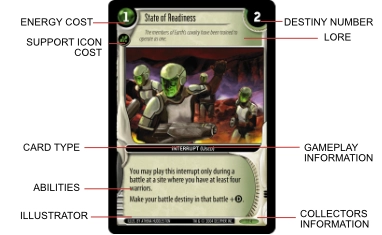
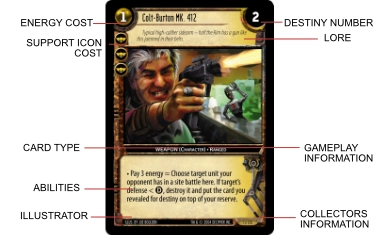
Any time you play a card, you must pay the costs listed in its upper left corner. There are two types of costs, energy cost and support icon cost. If you can’t fully pay a card’s costs, you can’t play it.
You pay the energy cost with energy from your active pile. Take that number of cards one at a time from the top of your active pile and put them on top of your used pile without looking at them.
You pay the support icon cost with your support icons of the appropriate type on locations. Your support icons are on your locations, on your side (the side facing you).
You want to play a card that costs 5 energy and three [EARTHER] support icons. You take five cards from the top of your active pile, one at a time, and put them on top of your used pile without looking at them. You use three [EARTHER] support icons, from three different locations that each have one [EARTHER] support icon on your side.
Support icons are not “used up” in any way when you play a card.
If you play a card that has a support cost of three [QUAY], and you have only three [QUAY] support icons, you may still play other cards that require [QUAY] support icons on the same turn.
In addition to energy costs and support costs, some cards have abilities describing other costs (such as losing energy or dismissing cards). All types of costs are paid at the same time.
If two or more of your cards in play have the same costs, you must pay for each separately. You can’t pay once to perform the effects of both.
If a card, ability, or action is canceled, prevented, or otherwise altered after you’ve paid its costs, those costs remain paid.
damage
During battle, units and ships can be damaged. When you damage a unit or ship, rotate it 90 degrees. While it’s damaged, it can’t be damaged again.
Often, cards are damaged as a result of the effect of one of your opponent’s weapon abilities. You may have to damage cards to satisfy attrition, and you also may have to damage cards to meet remaining casualties.
defense
Defense is a statistic found on units and ships. It used to satisfy attrition and reduce casualties during the battle phase.
deploy phase
In this phase during your turn, you may play cards from your hand when the stack is empty. There’s no limit to the number of cards you may play.
You may play interrupts and/or use activated abilities during this phase as well, before, between, and after you play cards.
Following are the steps involved with playing a card. If at any time while playing a card, its player cannot meet part of this procedure, then that card is played illegally and the player takes it back. (The game is then returned to the state it had right before this card was played.)
1. Declare card being played. Show the card from your hand and place it on the table. Card goes onto stack.
2. Meet all requirements. A card that has (D) in its game text requires the player who will be revealing a card to have at least one card in his or her reserve. If all requirements can’t be met, the card can’t be played.
3. Declare options: “choose one,” “used or lost,” variable costs, and so on.
4. Choose targets (how many, which). If the required number of legal targets can’t be chosen, the card can’t be played.
5. Pay and/or meet all costs. If all costs can’t be paid or met, the card can’t be played.
6. The card is now pending on the stack.
I declare that I am playing Sprinkle’s Deal, taking it from my hand and placing it on the table. I have two Maverick support icons, and I have some cards in my reserve for the (D) in the game text. I pay 3 energy, and the card is now pending. When it comes off the stack, I’ll reveal a card for destiny to see how many cards to draw (that’s the effect).
destiny
Destiny is a number that appears in the upper right corner of every card. These numbers are sometimes used to determine the outcome of an effect.
When you’re asked to reveal a card for destiny, reveal the top card of your reserve and note its destiny number. Then put the card on top of your used pile. Most cards tell you to do this by using the (D) symbol. Any time you use a card that includes this symbol, reveal a card for destiny and replace the (D) with the number you reveal.
You play a card that says “Draw (D) cards from your reserve.” When you play it, you reveal the top card of your reserve and note it has destiny 3. You put the card you revealed on top of your used pile, then draw three cards from your reserve.
Some cards use the phrase “opponent’s (D),” meaning your opponent reveals the top card of his or her reserve (putting it in his or her used pile afterward), and you should note that card’s destiny.
An interrupt or activated ability that has (D) in its game text cannot be played or used if the player required to reveal a card has no cards in his or her reserve.
You can’t play Cloud (“Damage target unit if opponent’s (D) < the number of fighters you have at that sector”) if your opponent has no cards in her reserve.
If you are required to reveal a card for destiny as part of the effect of an ability or card and you no longer have any cards in your reserve, that (D) = 0.
Both players have one card in their reserves. You play Sprinkle’s Deal. Your opponent uses the ability on Damir Quarrel. The Quarrel’s ability resolves first, and both players reveal a card for destiny. When your Sprinkle’s Deal then resolves, you have no cards in your reserve, and that (D) = 0. Note that players properly checked to see if there were cards for each (D) when the card (or ability) was put on the stack.
destroyed, dismissed, lost
A card in play can be destroyed or dismissed, which puts it into its owner’s lost pile. If you’re told to dismiss a card, you must choose one of your own cards. If you’re told to destroy a card, you must choose one of your cards or one of your opponent’s.
A card that is lost is not necessarily dismissed or destroyed.
A card that is destroyed is not dismissed, although it is lost.
A card that is dismissed is not destroyed, although it is lost.
Cards which are not in play (such as lost cards or pending cards on the stack) can’t be destroyed or dismissed.
diamond (•) symbol
A diamond (•) symbol before a card’s title signifies that card is unique.
download
When you download a card, search your reserve for that card, reveal it to your opponent, and put it in your hand. Then shuffle your reserve. If you don’t find the card or if you find it and don’t wish to put it in your hand, then simply shuffle your reserve.
drain action
You may perform a drain action during your control phase when the stack is empty once at each target location that you control that has at least one energy icon on the side facing your opponent.
Each location may have only one drain action targeting it during each control phase, but units and/or ships may be used to control more than one location for drain actions in each control phase.
When your drain action resolves, your opponent loses 1 energy for each energy icon on the side of the location facing him or her.
You have three units at a site that has two energy icons on your opponent’s side. He has no units at that site. You drain at that site, so your opponent loses 2 energy. He does this in any combination from his reserve, active pile, and used pile. He can also lose cards from his hand. He decides to lose a card from his hand, and the top card of his reserve. You can’t drain again at the same location this turn.
Cards and abilities that modify a drain (like “each of your opponent’s drains is –1”) modify the drain action when it comes off the stack.
Triggered abilities that use a phrase like, “Each time your opponent drains...” or “Each time you drain...” trigger when a drain comes off the stack.
draw phase
In this phase, you may draw cards from the top of your active pile. There’s no limit to the number of cards you may draw. Each card drawn is a single draw action. You may see the card you get when you perform one draw action before deciding to draw another. A draw action does not go on the stack. You may perform a draw action only when the stack is empty.
You may play interrupts and/or use activated abilities during this phase as well, before, between, and after you perform draw actions.
effects
When a card or ability comes off the stack (resolves), usually an effect is created. Ongoing abilities also create effects. Some effects are systemic effects, provided by the game rules themselves. Effects don’t go on the stack.
When the effects of a card, ability, or phase action require you to do something you can’t, do as much as you can and ignore the rest.
An effect tells you to damage two of your units in a battle and you have only one. You damage that one.
You may pay costs for a card, ability, or phase action even if it will produce no usable effect. However, you must choose all targets for it when you play that card or perform that ability or phase action.
Some interrupts, orders, and abilities affect multiple cards at one location until end of turn. Those effects apply only to cards at the location at the time the interrupt or order is played, or the ability is used or triggered. Those effects don’t affect cards played at or moved to that location later in the turn.
You use an activated ability that has the effect “Make each of your units here power +1 until end of turn.” Only the units at that location when you use the ability get power +1. They are still power +1 if they move to a different location later. Other units played at or moved to that location later in the turn are unaffected.
When a card (or ability) comes off the stack, if any of its targets are no longer legal, or any of its other requirements are no longer met, the effect of that card (or ability) is canceled.
You play Anticipation, but when that card comes off the stack, your target is no longer a kizen. The effect of Anticipation is canceled, and the card goes to your used pile.
You target your kizen with Anticipation. I play Faded, making your kizen untargetable by you. Faded comes off the stack first, the effect of your Anticipation is canceled, and the card goes to your used pile.
When an effect needs information such as number of cards in hand, that information is determined when the effect happens.
You play Overburdened when I have 13 cards in my hand, but when it comes off the stack, I have only 12 cards. It doesn’t have its effect, and it goes on top of your used pile.
The effects of multiple copies of the same card are cumulative.
You have two copies of Dedication in play. Your damaged characters and fighters are each defense +2.
When the effect of a card gives you a choice, you must choose an option you can perform, if possible.
If you have no energy in your active pile when your opponent plays Syndicate Interference, you must choose to dismiss each unit at the drain location.
encampment
A location that has this keyword can either be played normally as a separate location, or stacked beneath target location already in play (similar to the way a weapon is played beneath the card it’s given to). An encampment that’s stacked beneath a location is no longer a site or location.
The location you stack the encampment beneath must have at least one energy icon on your side, unless you have a ship or a unit at the location. Each player may stack only one encampment beneath a given location.
Any energy icons and support icons on your side of the encampment are added to those on your side of the location you stack it beneath. Any icons on your opponent’s side of the encampment are ignored.
You play an encampment beneath a sector that has two energy icons on your side and one energy icon on your opponent’s side, and a [Earther] support icon on the side facing you. The encampment has one energy icon and a [Gongen] support icon on the side facing you. The two cards are now treated as a single location that has one energy icon on your the side facing your opponent, and three energy icons, a [Earther] support icon, and a [Gongen] support icon on the side facing you.
end of turn
When you complete all six phases of your turn, all effects that last until “end of turn” expire. Both players recirculate their own used piles to the bottom of their reserves. Any energy remaining in a player’s active pile remains there. Your opponent then begins his or her turn.
energy
Energy is your most important resource. Each card in your deck is 1 energy. During the game, your energy flows through three piles (reserve, active pile, and used pile), and any of your cards that isn’t in one of them is no longer energy. You will be required to lose energy at various times during the game. If you have no energy remaining, your opponent wins the game.
energy icon
Each location, even one your opponent played, generates for you 1 energy for each energy icon on your side (the side facing you). When you perform an activation action, total the amount of energy generated for you on all locations, then add 1 to that total. You may activate up to this much energy.
factions
In the future setting of WARS TCG, five factions battle for supremacy in our Solar System, sometimes making uneasy alliances with one another to fight mutual threats. These five factions are: Earther, Gongen, Maverick, Shi, and Quay. In addition, Independent forces are employed by each to augment their strength.
Each card in WARS TCG either belongs to one of the five factions, or it is independent. Color, background texture, and the support icon cost along the left edge of a card indicate which faction. Once in play, cards from different factions (and independent cards) may mix freely during the game.
game text
Only text that appears in the large box at the bottom of a card (where the abilities are found) is game text.
greater than (>) symbol
This symbol creates a condition requiring that the quantity to the left of the symbol must be greater than the quantity to the right. Remember that the “arrow” always points to the smaller number.
When a card says, “If (D) > opponent’s (D),” your destiny must be greater than your opponent’s destiny. If your opponent’s destiny is 3, your destiny must be 4 or more.
helper text
Game text in (parentheses and italics) reminds players how the rules work. Helper text often follows a keyword.
here
When a card uses the word “here,” that means the location that card is at. If a location card uses the word “here,” it’s referring to itself.
in a battle
A card is in a battle when it is at the location targeted by the current attack action. A card which is in a battle and moves to another location is no longer in that battle (the reverse is also true).
A card which is not in a battle can affect cards which are in a battle.
A card which is not in a battle can affect other cards which are not in a battle, while that battle is occurring.
You play Armor Penetrating. Your Plasma Cannon targets a vehicle in a battle at an adjacent site. When the Plasma Cannon damages the vehicle, you choose two target characters at the Plasma Cannon’s site to be damaged.
initiative
Only one player has initiative, and he or she is the only player who can play an interrupt or use an activated ability. During your turn, you can also perform a phase action associated with the current phase, as long as the stack is empty.
You gain initiative:
1) During your turn, at the start of each phase.
2) During your turn, after a card, ability, or action is taken off the stack and its effects are performed.
3) During a battle phase on your turn, after each step has ended.
4) During any turn, if your opponent has initiative and passes.
Your control phase begins, and you gain initiative. You could play an interrupt, use an activated ability, pass, or (because its your turn and the stack is empty), take a drain action. You choose that last option. You still have initiative after placing the drain on the stack, giving you the first chance to respond. You pass, giving your opponent initiative.
Your opponent plays an interrupt, adding it to the stack. He still has initiative, but passes it to you. You also pass, so your opponent takes his interrupt off the stack and performs its effects. You again gain initiative. You pass, and so does your opponent, so your take your drain off the stack and perform its effects – your opponent loses energy.
Neither player may have or gain initiative during a battle step. After each battle step, the attacker gains initiative, but the player who has initiative loses it when the next battle step begins.
interrupt
An interrupt can be played during any phase of either player’s turn.
You may play an interrupt at any time when you have initiative. Interrupts are the only cards you can play when it’s not your deploy phase. When you play an interrupt, it goes on the stack.
There are three kinds of interrupts: (USED), (LOST), and (USED OR LOST). When an interrupt comes off the stack, place it in your used pile or lost pile, depending on its kind. (USED OR LOST) means that you choose one of two effects when you put it on the stack. That choice determines whether the card is placed in your used pile or lost pile.
If an interrupt is canceled (by a card that says “cancel target pending interrupt”), then its effects are canceled and that interrupt card goes to the lost pile regardless of its kind.
An interrupt never enters play. An interrupt card has all its effects resolved before it is put in its appropriate pile.
Some interrupts have one or more bullet (•) symbols before their titles. You can only play an interrupt with that title once during each player’s turn for each of those symbols.
inverter
Each card that has this label on its card type line has a separate set of power, tactics, and defense statistics, and sometimes abilities. This second set is printed upside-down on the bottom edge of the card.
When an inverter enters play, it does so right-side up. You ignore the power, tactics, defense, and abilities that are upside-down. If an effect later tells you to invert that inverter, rotate it 180 degrees. Once the card is inverted, you ignore the original power, tactics, defense, and abilities, and use the set that is now right-side up.
Invert means to take a card that has the label INVERTER that is right-side up and rotate it 180 degrees. You can’t invert an inverted inverter, although you can revert such a card.
keyword ability
A keyword ability is found at the beginning of a card’s game text, written in boldface. Each keyword is a separate ability, although sometimes they’re found on the same line, separated by commas.
Some keywords are followed by numbers, and if a card gains that keyword again, the numbers are added together.
Scouting is a keyword without a number. Piloting is a keyword that is always followed by a number. A character with Piloting 1 who gains Piloting 2 now has Piloting 3. Some cards list keywords with commas and no helper text such as Size 2, Transport 2.
Each keyword ability has its own game rules. Many keyword abilities also have helper text to remind players how they work.
label
A label is a word preceded by a bullet (•) on a card’s card type line, written in SMALL CAPS with no (parentheses). A label is a “handle” for another card’s ability to use. Labels are derived from the story of the game, and they have no associated gameplay.
Some labels identify a unit as part of a group in the game’s story. Shi families, Earther corporations, Maverick gangs, and Quay tribes are examples of groups.
Other labels define how a card works, such as KIZEN, WARRIOR, INFILTRATOR, MELEE, RANGED, FIGHTER, or CAPITAL. The label of UNIT is found on every character, vehicle, and NōBot.
less than (<) symbol
This symbol creates a condition requiring that the quantity to the left of the symbol must be less than the quantity to the right. Remember that the “arrow” always points to the smaller number.
When a card says, “Damage target if its defense <,” the destiny must be greater than the target’s defense statistic. A target with defense of 3 is damaged with a destiny of 4 or more.
location
A location is a place in the Solar System which you and your opponent battle to control. A sector represents a location in space, while a site represents a ground location on a planet, moon, station, or asteroid.
You may play a location when the stack is empty during your deploy phase.
There are two kinds of locations: (SITE) and (SECTOR). Locations don’t have an energy cost or a support icon cost. When a location enters play, you must play it next to other locations that are related to it.
Locations provide energy icons to help you and your opponent play your cards. Some face your side, and some face your opponent’s side.
Most locations provide a support icon for one of the five factions: Earther, Gongen, Maverick, Shi, and Quay.
Some locations are encampments, and they may be played beneath another target location.
playing a location
Locations have no energy cost or support icon cost to be paid. Your locations and your opponent’s mix together in the play area. There are two types of locations, sectors and sites.
The locations you play always face you in the play area. Energy icons on the bottom of that location are yours (on your side). Other energy icons on the top edge of your location are your opponent’s (on his or her side).
Each site must be played adjacent to a related site, if another such site is already in the play area. If multiple related sites have already been played, you may play the new site on either end of that group, or insert it in between any two of those sites. If there are no other sites related to the one you’re playing, separate it from other locations in the play area. The arrangement of sites impacts the strategy of the game, and once played, they can’t be changed.
Sectors are played on one end of the group of sites related to them, if such sites are already in the play area. If there are no locations related to the sector you’re playing, separate it from other locations in the play area. Sectors are grouped with sites for easier reference, and the order of multiple sectors related to a group of sites is unimportant.
A location is not related to itself.
A sector is never adjacent to a site. A sector is never adjacent to another sector.
lose energy
During a game, you will often have to lose energy (the cards in your reserve, active pile, and used pile). When you lose an amount of energy, you take that number of cards one at a time from the top of any of these three piles, in any combination, and put them face up in your lost pile. You can also choose to lose a card from your hand in place of losing 1 energy, even though cards in your hand are not part of your energy.
You’re required to lose 4 energy. You can choose to first lose a card from your hand, then a card from the top of your used pile, and finally two cards from the top of your reserve. You make these decisions as you go, because you put all these cards in your lost pile one at a time.
lost pile
Lost piles are kept face-up, and cards are always put in it one at a time so all players can see what is being lost. The order of your lost pile is irrelevant. You may look through either player’s lost pile at any time. Each time you take a card from your lost pile, you must reveal that card to your opponent.
When a card is lost, put that card in its owner’s lost pile.
If a lost pile is randomized after one of its cards is targeted, then any copy of the same named card may be targeted instead.
You play Sheltered and target one of three Resource Technicians in your lost pile. Before Sheltered comes off the stack, your lost pile is randomized by a retrieval. Neither player knows if one of the two Resource Technicians left is the one you chose, but you can play either one.
modifiers
Any time one or more modifiers are applied to a number, if the final result is less than zero, that result is changed to zero.
Your opponent plays an interrupt that says “Make target unit power –3 until end of turn” targeting your unit with power of 2. Because the result of this would be less than zero, your unit now has power 0.
Each time a new modifier is applied to the same number, determine the result by reapplying all modifiers still affecting that number.
On the same turn, you now play an interrupt targeting the same unit that says “Make target unit power +4 until end of turn.” Your opponent’s modifier still affects the unit, so you reapply all modifiers. 2 – 3 + 4 = 3, so your unit now has power 3.
move phase
In this phase, you may perform movement actions to move your ships and units. There’s no limit to the number of ships and units you may move.
You may play interrupts and/or use activated abilities during this phase as well, before, between, and after you perform movement actions.
movement actions
You may perform movement actions only during your move phase when the stack is empty. Each movement action costs you 1 energy. You may perform more than one movement action with the same ship or unit during the same move phase.
There are five different ways a card can be moved with a movement action. You must state which one you’re doing, which ship or unit you’re moving, and where you’re moving it to at the time you pay the cost of the movement action. The five ways are:
Move target ship you have at a sector to another target sector.
Move target unit you have at a site to target adjacent related site.
Move target unit you have at a site, putting that unit aboard target ship you have at a related sector, if capacity allows.
Move target unit you have aboard a ship at a sector, putting that unit at target related site.
Move target unit you have aboard a ship at a sector, putting that unit aboard a different target ship you have at the same sector, if capacity allows.
When a card uses the word “movement,” it is referring to one of these five forms of the movement action. Other abilities allow you to “move” cards for other costs. You don’t pay an additional 1 energy when using such an ability.
Your ship has the ability “Pay 3 energy ≈ Move target vehicle from aboard this ship to a related site.” You are not using a movement action, so your cost is 3 energy, not 4.
When you move a card, any weapons or assets beneath it move with it. When you move a ship, any units, weapons or assets aboard it move with it.
NōBot
A NōBot is a type of card that represents a bot which you send into battle against your opponent’s forces at ground locations.
You may play a NōBot when the stack is empty during your deploy phase.
You must choose either target site or your target ship where your NōBot will enter play.
If you choose a site, it must have at least one energy icon on your side of it, unless you already have another unit at that site.
If you choose your ship, it must have sufficient capacity remaining. Play your NōBot aboard (stacked beneath) the ship.
Each character, vehicle, and NōBot has the label of UNIT.
ongoing ability
An ongoing ability is any ability on a card which is not an activated ability or a triggered ability. Its effect is constant, lasting as long as the card remains in play.
Your unit has the ability “Each unit you play at a related site costs 1 less energy to play.” This is an ongoing ability.
Some ongoing abilities begin with the words “as long as.” They have a stated condition which means their effect is “on” while that is true and “off” when it is not.
Your character has the ability “As long as this character is at a site where you have a vehicle, this character is power +2.” This ability starts working when a vehicle is there, and stops when there are none.
Some ongoing abilities apply while a card is in your hand (or your lost pile, or stacked on another card). These include abilities that begin with, “You may play...” and “You may only play...”
Some ongoing abilities apply while a card is on the stack. These include abilities that begin with, “As an additional cost to play...”
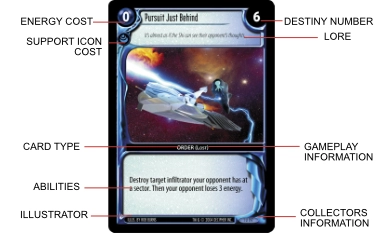
order
You may play an order when the stack is empty during your deploy phase.
There are two kinds of orders: (USED) and (LOST). When an order comes off the stack and has its effect, place it in your used pile or lost pile, depending on its kind.
If an order is canceled (by a card that says “cancel target pending order”), then its effects are canceled and that order card goes to the lost pile regardless of its kind.
An order never enters play. An order card has all its effects resolved before it is put in its appropriate pile.
pay
Energy in your active pile can be used to pay energy costs for your cards. When you pay an amount of energy, you take that number of cards one at a time from the top of your active pile and put them on top of your used pile without looking at them.
pending
While a card or ability is on the stack, it is pending. Some text refers to pending cards or abilities. That means something on the stack.
You play a ship in your deploy phase, and that action goes on the stack. Your ship is also pending, and not yet in play. Other cards or abilities may cancel or modify your pending ship.
Pending cards, abilities, or phase actions can be canceled. You remove the canceled card, ability, or phase action from the stack, without changing the order of other things on the stack. Any effects of the canceled card, ability, or phase action aren’t performed.
You play an interrupt that says “Cancel target pending order.” The target for that interrupt must be an order on the stack. You cancel the order by removing the order from the stack without performing its effects.
A card that is the target of an ability that moves that card is not a pending card.
You move a unit with a port’s ability, which makes that ability pending when it goes on the stack. The moving unit is not a pending unit, since it’s only pending when it enters play.
phase actions
Most phases of the turn have a special action that can only be used during that phase. These include activation (activate phase), drain action (control phase), attack action (battle phase), movement (move phase), and draw action (draw phase).
piloting
This keyword ability is followed by a number: Piloting X. Its helper text is: (As long as this character is aboard a ship, that ship is power +X and tactics +X.) Piloting is an ongoing ability.
power
Power is a statistic found on units and ships. It used to determine casualties during the battle phase.
quickdraw
This ability on a card adds one or more bullets (•) to any activated abilities that already have a bullet on a weapon beneath that card. The number of bullets added is equal to the number after Quickdraw (“Quickdraw 2,” for example). Each bullet added allows another use of that ability during the same turn.
recirculate
Energy in your used pile recirculates at the end of each turn for you to eventually activate and pay energy costs all over again.
At the end of both player’s turns, each player recirculates his or her used pile by taking those cards and placing them beneath his or her reserve. Make sure you don’t look at, reveal, or change the order of these cards.
related
Each location has a slash (/) in its title. If the part of a location’s title before the slash is the same as that part of another location’s title, those locations are related.
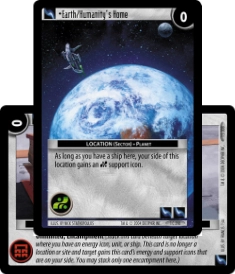
The locations Ganymede/Traginium Source, Ganymede/Core Shaft, and Ganymede/Mining Platform are all related. None of these locations is related to Earth/Humanity’s Home.
“removed from the game”
When an ability includes this phrase, set that card aside so that it can’t be used in the current game and doesn’t affect that game. When that game is done, put that card back in its owner’s deck.
replacement effect
Some effects, once they are generated, watch for a specific event and replace that event with another event. Because such an effect doesn’t use the stack, it doesn’t have to wait for a player to gain initiative.
When you use First Aid and your target unit is about to be destroyed in the end of battle step, the effect of First Aid prevents that even though during the end of battle step neither player has initiative and that prevention effect doesn’t go on the stack.
A replacement effect often uses the word “instead.” A particular event is described, and then a second event is described that happens in the place of the first event. The first event never happens.
Shift in Tactics says, “The next time you would reveal a card for battle destiny, make your battle destiny +X instead, where X is the tactics of target unit you have in this battle.” A card is never revealed for battle destiny, and another number is used in its place.
You can’t replace a single effect more than once.
If you play two copies of Shift in Tactics, the first replaces the revealing of battle destiny, and since the second has no other event to replace, it is canceled when the battle ends. Remember, only the systematic card revealed for battle destiny counts for cards like Shift in Tactics.
Some replacement effects use the word “prevent,” which means the event they watch for is replaced with nothing (it doesn’t happen).
reserve
When you are starting the game, after removing your starting location, you shuffle the rest of the cards in your deck and place them face down on the table to become your reserve.
retrieve
When an effect lets you retrieve a card, choose a card at random from your lost pile, reveal it to both players, then put it on top of your used pile.
revert
When you revert an inverted inverter, rotate it 180 degrees back to its uninverted state. You can’t revert an inverter that’s not inverted. When an inverted card is reverted, its original power, tactics, defense, and abilities are used.
rift (≈) symbol
A rift (≈) symbol separates the cost and effect in the game text of an activated ability.
scouting
This keyword ability’s helper text is: (You may play this [character/ship] at a sector that has no energy icons on your side.) This keyword ability is found on characters and ships. Scouting is an ongoing ability.
sector
A sector is a space location in the Solar System which you and your opponent battle to control. Sectors have labels such as PLANET, MOON, and ASTEROID.
ship
A ship is a large capital or smaller fighter which battles your opponent’s forces in space.
You may play a ship when the stack is empty during your deploy phase.
You must choose target sector where your ship will enter play. That sector must have at least one energy icon on your side of it, unless you already have another ship at that sector.
Each ship either has the label of FIGHTER or CAPITAL.
site
A site is a ground location in the Solar System which you and your opponent battle to control. Sites have labels such as UNDERGROUND and PORT.
size
This keyword ability is followed by a number: Size X. Its helper text is: (This vehicle counts [X times] against a ship’s capacity.) The vehicle counts “twice” for Size 2, “three times” for Size 3, and so on. Units which do not have this keyword ability are “Size 1.” This keyword ability is found on vehicles and NōBots. Size is an ongoing ability.
One of your ships has capacity 4, and has one size 1 unit aboard it. If you play a size 2 unit aboard it, there will be room for only one more unit of size 1 aboard it.
the stack
Each time a player plays a card or uses an ability, it is placed on “the stack” while players decide if they wish to respond by playing an interrupt or using an activated ability. This point of decision comes after any costs are paid for the card or ability, but before its effects are performed. (In the case of a location, unit, ship, weapon, or asset, the “effects” are often simply that the card enters play.)
The stack is more of a helpful concept than an actual physical stack of cards. While it may be helpful to make a stack of cards like interrupts, using activated abilities on characters or weapons doesn’t mean you should place those cards on a physical stack.
The actions you are allowed to perform during certain phases of your turn are also placed on the stack: activation (activate phase), drain action (control phase), attack action (battle phase), movement (move phase), and draw action (draw phase). These are called phase actions. Phase actions can only be placed on the stack when the stack is empty.
In most cases, neither player will want to respond to a card, ability, or action.
During your move phase, you use the movement action, announcing that you are moving one of your units to an adjacent site. After you pay the 1 energy for this action, but before you perform its effects, both you and your opponent could respond with an interrupt or activated ability. Neither of you do, so you perform the effect of moving your unit.
When something is placed on the stack, and a player does respond with an interrupt or activated ability, it in turn is also placed on the stack. This creates an opportunity for further responses. Things pile up in order on the stack until both players pass consecutively on the chance to respond. At that point, the card or ability most recently added to the stack is taken off, and its effects are performed.
You pay 1 energy to move another unit, and this time your opponent responds with an interrupt. After he pays its costs and places it on the stack, you respond with an activated ability and place it on the stack. You both pass on the opportunity to respond further, so you take your activated ability off the stack and perform its effects.
Each time a card or ability is taken off of the stack, players have another opportunity to respond with an interrupt or activated ability. Each time both players pass on an opportunity to respond, the card, ability, or phase action most recently added to the stack is taken off, and its effects are performed.
After you perform the effects of your activated ability, you both pass on the opportunity to respond. Then your opponent takes his interrupt off the stack and performs its effects. You both pass again, so now you take your original movement action off the stack and perform its effects, moving your unit as originally announced.
If both players pass consecutively when the stack is empty, proceed to the next phase of the turn or, during a battle, to the next step of that battle.
You have no more movement actions you wish to perform, nor do you wish to play an interrupt or use an activated ability. You pass. Your opponent passes too, so you proceed to your draw phase.
An activated or triggered ability on the stack is not canceled when it’s source is removed from play.
You use a Plasma Cannon to target my unit, putting that ability on the stack. I play Consultation, targeting your vehicle with the Plasma Cannon. Consultation comes off the stack and your vehicle is destroyed, and then your Plasma Cannon ability has its effect, even though that card has left play.
When a card (or ability) comes off the stack, if any of its targets are no longer legal, or any of its other requirements are no longer met, the effect of that card (or ability) is canceled.
support icons
When you play a card, you have to meet its support cost, as shown by small icons stacked vertically below the card’s energy cost. (Locations and independent cards have no support cost.)
You use the large support icons on your side of locations in play to meet the support cost of playing a card. Support icons are not “used up” and may be used to meet the support cost of more than one card.
tactics
Tactics is a statistic found on units and ships. It used to reveal cards to add to battle destiny during the battle phase.
target
When one of your cards uses the word “target,” you choose something for that card to affect unless the card says “your opponent chooses target _____.”
You play a card which says, “Destroy target asset.” You choose which asset in play is to be destroyed.
You may normally target your cards and your opponent’s cards. If something is restricted to one player, it will say “your target X” or “your opponent’s target X.”
Junshi says, “Destroy target asset,” which means that you may choose any asset in play, yours or your opponent’s.
The criteria for choosing a target are based on what comes after the word “target.”
Sheltered says “Play target Gongen unit from your lost pile,” so the only criteria for a legal target are (1) it’s a Gongen card, (2) it’s a unit, and (3) it’s in your lost pile. You don’t have to be able to play it when you target it. When Sheltered comes off the stack and has its effect, you play the card and have to check for things such as uniqueness.
You can’t play a card, use an ability, or perform a phase action that uses the word “target” unless the proper type and number of targets can be chosen. You can’t choose the same target multiple times.
When you choose a new target for a card or effect, you must choose another legal target.
When you choose a new location for a pending ship with Portent, you must choose another legal location for that ship to enter play.
timing
Most things you do in the game must happen at specific times during your own turn, such as draining during your control phase, or attacking during your battle phase. But you can also play interrupts and use activated abilities, not only during any phase of your own turn, but during your opponent’s as well. This freedom means that sometimes both players will want to do something at the same time. These situations are handled through the use of the stack and initiative.
title
A card’s title is in large type just to the right of its cost number. Many cards have diamond (•) symbols to show they are unique. Some interrupts have bullet (•) symbols to show that the number of copies of that card you can play each turn is limited. Locations have a slash (/) that determines what other locations are related to them.
transport
This keyword ability is followed by a number: Transport X. Its helper text is: (Each time this vehicle performs a movement action, you may move with it [up to X] of your characters.) The vehicle moves “one” character for Transport 1, “up to two” characters for Transport 2, and so on. You don’t have to pay additional energy to move these transported cards. This keyword ability is found on ships and vehicles; ships move fighters and vehicles move characters. Transport is a triggered ability.
You may only use the Transport keyword when the card with that ability performs a movement action during your move phase. You can’t use Transport with other kinds of movement.
You have Ranarti-Anant aboard the Zocho with four fighters at the same sector. You use Ranarti-Anant’s text to move the Zocho to another sector battle during your opponent’s turn. You can’t use the transport keyword on the Zocho to move the fighters.
triggered ability
A triggered ability is any ability beginning with the words “when,” “each time,” or “at.” The text then describes a specific event that can occur in the game.
Your unit has the ability “Each time one of your units here is damaged, activate up to 2 energy.” The “each time” at the beginning tells you this is a triggered ability. It is triggered each time one of your units at the same location is damaged.
Triggered abilities can trigger at any time, including during a battle step or the resolution of an effect. They don’t go on the stack until a player gains initiative. Each time a player gains initiative, each ability that has triggered is put on the stack (if it hasn’t already been put on the stack).
Exception: Triggered abilities that affect a battle step go on the stack and resolve immediately, even though neither player has initiative at that time.
You reveal a 5 for battle destiny, and Price of the Game is triggered. Since this is a triggered ability that modifies the outcome of this step, it takes effect immediately during the battle destiny step. You lose 1 energy to add 1 to the destiny of the card you revealed for battle destiny. This triggers your Razorjack, but that has to wait until a player gains initiative. Then, your opponent reveals battle destiny, the battle destiny step ends and you receive initiative. Then, the effect on your Razorjack goes on the stack.
Sometimes, an event in the game will trigger more than one triggered ability at the same time. If this happens during your turn, you choose the order in which those abilities are added to the stack.
During your turn, you draw a card. Your opponent’s card says: “Each time a player draws a card, you may activate 1 energy.” Your card says: “Each time you draw a card, your opponent loses 1 energy.” It’s your turn, so you decide your opponent’s triggered ability goes on the stack first, followed by yours. Your opponent loses 1 energy, then activates 1 energy.
If one or more triggered abilities are triggered at a time when the player who has initiative wants to play an interrupt, use an activated ability, or perform an action, all the triggered abilities are put on the stack first.
Decisions such as choosing targets and checking for cards in reserve are made for triggered abilities when they go on the stack. In the same way that interrupts and activated abilities work, if you can’t meet requirements such as choosing targets at the time a triggered ability goes on the stack, that ability is canceled. These requirements must be re-checked when a triggered ability comes off the stack.
Multiple triggers from one event go on the stack one at a time and are resolved in the usual manner.
When a Clanton Grav Grenade damages four units and Cruel Lesson is in play, the first time Cruel Lesson triggers and goes on the stack it has no effect (because there is no other damaged unit). The other three times that Cruel Lesson triggers it has its effect and the player loses 6 energy total.
Some abilities, once they resolve, created a delayed triggered ability that waits until a game state is met, at which time that delayed triggered ability goes on the stack.
Before the end of battle step, you use the ability of Alnak Station/Hallway to target your damaged unit. During the subsequent step, that unit is lost, creating a delayed triggered ability that goes on the stack as soon as a player gains initiative (when the end of battle step ends).
types of cards
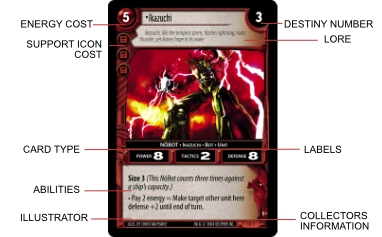
There are nine card types in the game: character, NōBot, vehicle, ship, weapon, asset, order, interrupt, and location. The layouts of some of these card types appear similar, but the card type always appears on the card type line in the middle of the card, in CAPS, and can be used to tell them apart.
On that card type line, following the card type in CAPS, are other words called labels that can be used to identify a card. Also found on that same line is gameplay information in parentheses.
SHIP (CAPACITY 1) • FIGHTER means this card’s type is SHIP, with (CAPACITY 1) – a game term – and it has the label of FIGHTER.
undamage
When you undamage a unit or ship, rotate it 90 degrees back to its normal position. Only a damaged unit or ship can be undamaged.
unique
If a card has a diamond (•) before its card title, it’s unique. When you have a unique card in play, you can’t play another copy of it. Your opponent may also have a copy in play of his or her own.
Any card that doesn’t have a • before its card title is not unique. Each player may have any number of copies of those cards in play at the same time.
unit
This label is found on every character, NōBot, and vehicle.
unlimited
This keyword ability’s helper text is: (You may have any number of copies of this card in your deck.) Unlimited is an ongoing ability.
use as yours
When an effect lets you take an opponent’s card to “use as yours,” you treat it as though you originally played it, but your opponent remains the owner of that card. You can’t take a unique card to use as yours if you already have a copy of that card in play.
used pile
Each time a player pays an energy, that player moves the top card from his or her active pile to the top of his or her used pile. That card is moved face down. When a cost requires more than one energy, each card is moved one at a time.
vehicle
A vehicle is a war machine, and its crew, that battles at ground locations.
A vehicle is a card you may play when the stack is empty during your deploy phase.
You must choose either target site or your target ship where your vehicle will enter play.
If you choose a site, it must have at least one energy icon on your side of it, unless you already have another unit at that site.
If you choose your ship, it must have sufficient capacity remaining. Play your vehicle aboard (stacked beneath) the ship.
Each character, vehicle, and NōBot has the label of UNIT.
weapon
A weapon enhances the capabilities of one of your other cards.
You may play a weapon when the stack is empty during your deploy phase.
There are several kinds of weapons: (CHARACTER), (SHIP), (KIZEN), and so on. You must choose your target card of the that kind where your weapon will enter play, stacked beneath it.
You may play a WEAPON (SHIP) beneath any of your ships. You must play a WEAPON (FIGHTER) beneath your ship card that says FIGHTER.
You can only play a weapon beneath one of your cards.
Each card may have only one weapon beneath it. Weapons can’t be transferred from card to card. You can’t voluntarily dismiss a weapon in order to play another.
winning the game
You win the game if at any point your opponent has no energy remaining.
“your ______”
These words, when referring to any aspect of a card, always mean a card you have in play.
“Your unit” means a unit you have in play, “your warrior” means a warrior you have in play, and so on.
your opponent may use this ability
When an ability on your card has this phrase, the card “speaks” to your opponent. Where it says “you” and “your,” it means your opponent and his or her cards.
One of your locations says, “Move one of your target units here to a related site. Your opponent may use this ability.” When you use this ability, you move one of your units. If your opponent uses it, he moves one of his units. He can’t move your unit with this ability.
Section Three: Rulings
Individual card rulings are provided in this section. Unmarked rulings are clarifications that explain how a card works in the rules. Clarifications do not change the gameplay of a card.
A ruling marked as Erratum provides the complete revised text of a card. If a card with an erratum is ever reprinted (in a starter deck, for example), its revised text will be used to provide players with a correct version.
A ruling marked as Banned means that card can’t be used for sanctioned constructed tournament play. Banned cards can be used for limited play, including both sealed deck and booster draft.
CGC Grunt 1C7
Erratum: As long as your unit that has the highest tactics here has higher tactics than your opponent’s unit that has the highest tactics here, this character is power +2 and defense +2.
Heavy Juggernaut 1U26
When you play this card, if you have no other unit at its location, you must dismiss this card.
Howler’s Blades 1R29
When you play this card, if you have no other unit at its location, you must dismiss this card.
Shift in Tactics 1R43
You don’t need a card in your reserve to play this interrupt.
Zealous Squad 1C55
When you play this card, if you have no other unit at its location, you must dismiss this card.
Amorian Shipyard 1R56
When you play a fighter stacked on this asset, that triggers any “When this ship enters play...” ability on that fighter.
Komoku 1C83
Erratum: This ship costs 1 less energy to play at a sector for each site related to that sector where you have a unit.
Resource Technician 1C93
Some printings of this card omit the word “a” in “is at a site.”
Sheltered 1R97
Selection of targets is based on the words that come after “target,” not before. The only criteria for a legal target for Sheltered are that you have a Gongen unit in your lost pile.
When the card comes off the stack, you check to see if you can play the card, including such things as uniqueness and support icons.
Quarrel Energy Burst 1U98
Erratum: • Reveal a ship from your hand and put it on top of your used pile ≈ Your opponent chooses his or her target ship in a sector battle here and destroys it, unless he or she reveals a ship from his or her hand and puts it on top of his or her used pile.
Shikami Follower 1U99
Erratum: Dismiss one of your other units here ≈ Make your opponent’s battle destiny in target battle here –3.
Racing Sloop 1C146
Checking for 4 or more tactics takes place before battle destiny is revealed, so destroying a fighter with this ship’s ability won’t prevent a player from revealing a card for battle destiny.
My Racing Sloop with two Nimble Jockeys aboard is in a battle with your four Reliable Quarrels. Your battle destiny is revealed before I pay 3 energy and destroy one of your fighters.
Simple Wager 1R151
When you play this card, there can be less than two cards in your opponent’s reserve. If your opponent’s reserve has only one card when Simple Wager has its effect, use that card for the total destiny. If there are no cards, the effect of Simple Wager is canceled and it is put on top of your used pile.
This card allows movement actions (called “movements” in its game text) during a move phase. Note that this refers only to the five ways of moving with a movement action, and not other cards that say “move” like Themis/Landing Pad or Alnak Station/Launch Bay.
You can’t use transport with the movement actions from Simple Wager because transport can be used only with a movement action during your move phase.
Assailing Vatarma 1C168
Erratum: • Put a card from your hand on top of your used pile ≈ Your opponent chooses his or her target unit in a site battle here and damages it, unless he or she puts two cards from his or her hand on top of his or her used pile in any order.
Your opponent can’t choose a damaged unit.
Ominous Presence 1R192
Eligible means that card must be a legal target for that asset, as if the asset were being played.
You can’t move Ominous Presence to your opponent’s kizen, because that card would not be a legal target if you were playing Ominous Presence.
Reconnoiterer 1R199
Erratum: Scouting (You may play this character at a site that has no energy icons on your side.)
Put this character on top of its owner’s used pile ≈ Cancel target pending drain at an adjacent site.
Reliable Quarrel 1R200
When you play this ship using the ability of Amorian Shipyard (1R56), you may play it at no energy cost.
Transport Vessel 1R213
Erratum: • Pay 4 energy ≈ The next time your target unit in a battle at a related site is destroyed this turn, put it aboard this ship.
Kayaldi 1R239
Erratum: • Lose 2 energy ≈ The next time this character moves to a site where your opponent has a character this turn, reveal the top two cards of your used pile. If those cards are both units, you may destroy target character at that site.
Kucha 1U240
Erratum: This character is power +X, where X is the highest unmodified power on a character here.
Jack Wilgress has Indiscriminate Strike beneath him and Kucha is at the same site. Jack Wilgress is power 9, but Kucha is power 7.
Quay Navigator 1U252
Erratum: Piloting 1 (As long as this character is aboard a ship, that ship is power +1 and tactics +1.)
Put this character on top of its owner’s used pile ≈ Cancel target pending drain at a related location.
Tahka Quarrel 1U269
Erratum: Put this ship on top of its owner’s used pile ≈ Cancel target pending drain at a related location.
Chained 1U276
Erratum: Each time an interrupt is played, you may pay 3 energy. If you do, and there is no card stacked on this asset, stack that interrupt on this asset after its effects have been performed.
As an additional cost for a player to play a card that has the same title as a card stacked on this asset, he or she pays 3 energy.
Diplomacy Bot 1U278
Casualties happen in the Power Step, as soon as a loser is determined. This card reduces casualties to 5 before any reduction to casualties happens in the Loss Step.
Alnak Station/Hallway 1R294
Erratum: • Lose 1 energy ≈ The next time your target character is lost this turn, put it here. You may only use this ability if there are no characters here.
(This erratum has been changed since version 1.4 of the Comprehensive Rules and is already in effect.)
Titan/Raving Red’s Refuge 1R324
Erratum: • Lose 1 energy ≈ The next time your target fighter is lost this turn, put it here. You may only use this ability if there are no fighters here.
(This erratum has been changed since version 1.4 of the Comprehensive Rules and is already in effect.)
Talkan 1PF3
Banned: This card can’t be used in sanctioned constructed tournament play.
Life Leech 2R133
Erratum: As an additional cost to play this interrupt, put your other target character in a battle at the same location as your kizen on the top of its owner’s used pile.
Damage target character at that location.
Construction Bot 2C142
The support icon added by the effect of this card is added to your side of target location.
Geisha Bot 2C143
The support icon added by the effect of this card is added to your side of target location.
Hunter Bot 2C144
The support icon added by the effect of this card is added to your side of target location.
Porter Bot 2C146
The support icon added by the effect of this card is added to your side of target location.
Server Bot 2C149
The support icon added by the effect of this card is added to your side of target location.